
Bone & Joints
Rheumatoid Arthritis

BHMS — Classical Homeopathic PhysicianPublished 15 Mar 2026· Updated 1 Aug 2026
Constitutional homeopathic treatment to modulate autoimmune inflammation, reduce morning stiffness, and support conventional DMARD therapy — helping RA patients reclaim functional independence.
Overview
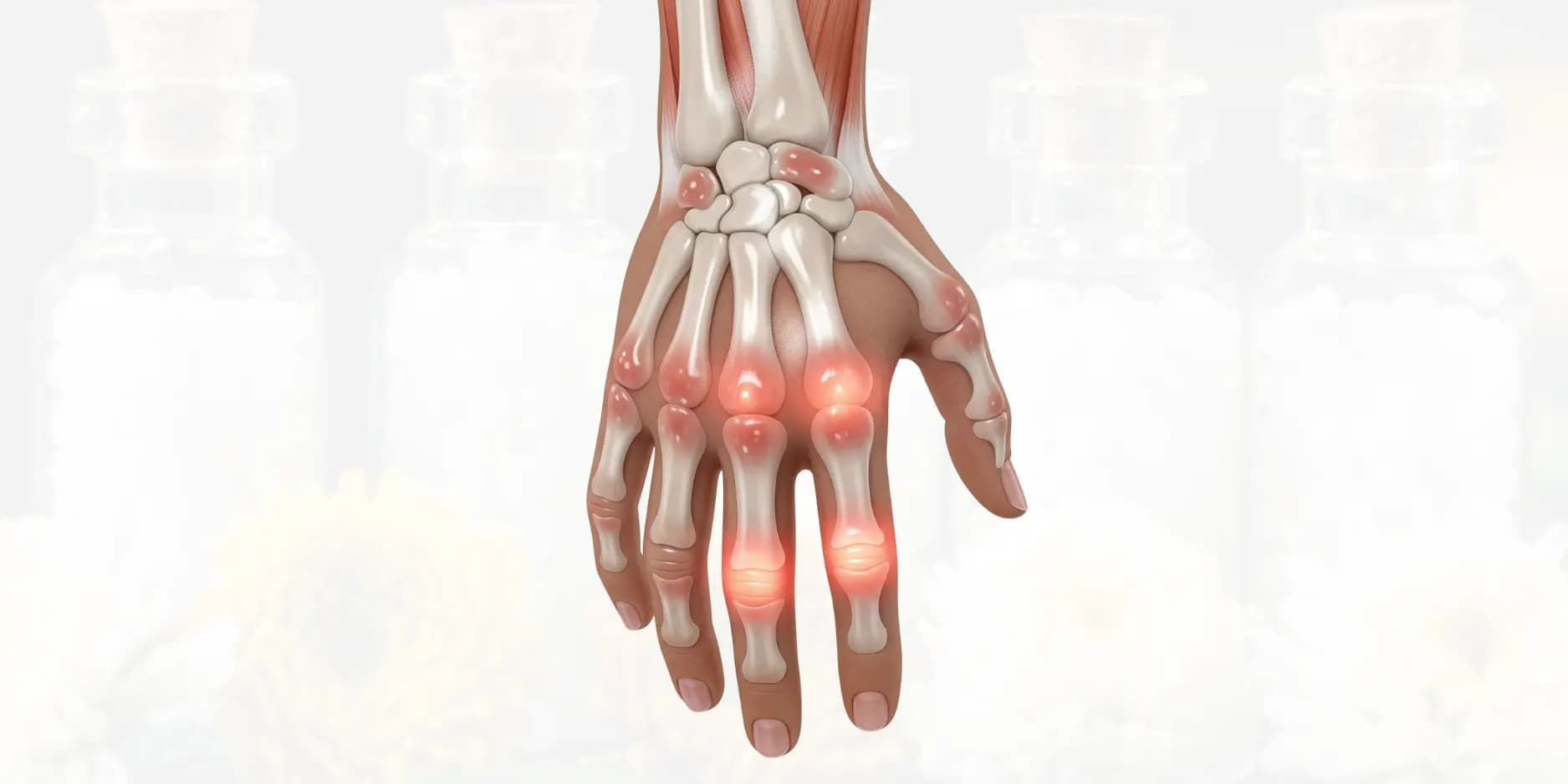
Rheumatoid arthritis (RA) is a chronic systemic autoimmune disease in which the immune system attacks the synovial lining of joints, causing progressive inflammation, pain, stiffness, and ultimately joint destruction. Unlike osteoarthritis, RA is not simply a wear-and-tear condition — it is driven by immune dysregulation and has wide-ranging systemic effects beyond the joints.
At HealthKunj, constitutional homeopathic treatment is used as an integrative complement to conventional rheumatological care — addressing the immune root of the disease, reducing systemic inflammation, and improving quality of life. We work alongside, not instead of, rheumatologists and DMARD therapy.
1%
Global prevalence of rheumatoid arthritis
3:1
Female to male ratio in RA
98%
Patient satisfaction at HealthKunj
What Is It?
RA is classified and managed according to disease activity, seropositivity, and degree of joint damage. Understanding these distinctions guides the intensity and composition of treatment at HealthKunj.
Seropositive RA
Positive for rheumatoid factor (RF) and/or anti-CCP antibodies. Generally more aggressive course with higher risk of erosive joint damage and extra-articular features.
Seronegative RA
Negative for standard antibodies but with clinical and imaging features of RA. May be more challenging to diagnose but responds similarly to constitutional homeopathic treatment.
Early RA (< 2 years)
The most treatable phase, when the inflammatory process can be most effectively modulated. Early initiation of constitutional homeopathy alongside DMARDs offers the best chance of sustained remission.
Common Symptoms
Symmetrical joint pain and swelling — both hands, both wrists, or both knees
Morning stiffness lasting more than one hour before joints loosen
Warm, tender, and swollen joints — particularly small joints of the hands
Fatigue disproportionate to the level of activity
Low-grade fever during disease flares
Loss of grip strength and difficulty with fine motor tasks
Rheumatoid nodules — firm lumps under the skin near joints
Joint deformity in advanced disease — swan-neck or boutonnière deformity of fingers
Elevated ESR, CRP, rheumatoid factor (RF), and anti-CCP antibodies on blood tests
Anaemia and elevated platelet count associated with systemic inflammation
Eye dryness and irritation (sicca symptoms) in some patients
Extra-articular features — lung involvement, pericarditis in severe disease
Benefits of Homeopathy for Rheumatoid Arthritis
Modulates the Immune Response
RA is driven by immune dysregulation. Constitutional homeopathy works at the systemic level to reduce the autoimmune attack on synovial tissue, addressing the disease process rather than simply suppressing symptoms.
Reduces Inflammatory Markers
Multiple clinical studies and observational series have documented reductions in ESR, CRP, and RF titres in RA patients receiving constitutional homeopathic treatment alongside conventional care.
Reduces Morning Stiffness Duration
One of the most consistent patient-reported benefits at HealthKunj is a significant reduction in morning stiffness — a hallmark RA symptom — within the first 4–8 weeks of treatment.
Allows Tapering of Steroids
Many RA patients are on long-term corticosteroids with their attendant risks. As homeopathic treatment reduces disease activity, patients and rheumatologists can often successfully taper steroid doses.
Safe Alongside DMARDs and Biologics
Homeopathic remedies do not pharmacologically interact with DMARDs or biologic agents. They can be taken throughout the course of conventional DMARD therapy.
Addresses the Mental-Emotional Dimension
RA frequently develops in the context of prolonged emotional stress, grief, or suppressed anger. Constitutional prescribing addresses these psychological triggers as integral to the disease pattern.
Our Homeopathic Approach
Comprehensive Autoimmune Case-Taking
We take a full history of joint involvement, disease duration, pattern of onset (sudden vs. gradual), triggering events (infections, emotional trauma, postpartum), and the precise character of pain and stiffness.
Review of Rheumatological Investigations
We review RF, anti-CCP, ANA, ESR, CRP, complete blood count, liver function (relevant if on DMARD therapy), and all imaging — X-rays showing erosions, ultrasound of synovial thickening, or MRI of affected joints.
Constitutional Remedy Prescription
Frequently indicated remedies for RA include Rhus Tox (better with continued motion), Bryonia (better with rest and pressure), Apis Mel (hot, shiny, stinging joint swellings), Causticum (with contractures), and Pulsatilla (wandering pains). Selection is always individual.
Coordination with Rheumatology Care
We never advise patients to stop DMARDs or biologics without rheumatologist guidance. We work within the patient's existing treatment structure, and communicate with rheumatologists when patients wish to taper medications.
Periodic Monitoring and Adjustment
Blood tests (ESR, CRP, CBC) are reviewed at 3 and 6 months. Remedy potency and prescription are adjusted based on response. Most patients notice sustained improvement over 6–12 months of consistent treatment.
Frequently Asked Questions
Can homeopathy stop the progression of joint erosions in RA?▾
No treatment can guarantee complete arrest of erosive disease, but constitutional homeopathy — when combined with appropriate DMARD therapy — appears to slow inflammatory activity and may reduce the rate of radiological progression. The goal is to achieve clinical remission and preserve joint function.
I was recently diagnosed with RA. Should I start homeopathy immediately or wait?▾
Early treatment is best. If your rheumatologist has started DMARDs, we recommend beginning constitutional homeopathy alongside them promptly. Early intervention with both modalities gives the best chance of achieving remission and minimising joint damage.
Can I take homeopathic treatment if I am on DMARD therapy?▾
Yes, completely safely. There is no pharmacological interaction between homeopathic remedies and conventional DMARDs. Many patients at HealthKunj take constitutional homeopathic treatment throughout their DMARD therapy.
How will I know if homeopathy is working?▾
The earliest signs of response are typically a reduction in morning stiffness duration, improved energy levels, and reduced pain intensity. Blood markers (ESR, CRP) typically improve after 3–4 months of sustained treatment. We track both subjective symptoms and objective markers at follow-up visits.
Is RA common in young women in India?▾
Yes — RA has a female-to-male ratio of approximately 3:1 and frequently presents in women aged 30–50. Post-partum onset is also well recognised. Homeopathy has a particularly strong track record in post-partum RA, addressing both the hormonal and emotional components.
Can diet changes help RA alongside homeopathic treatment?▾
Yes. An anti-inflammatory diet — rich in omega-3s, turmeric, green vegetables, and low in refined sugar, processed foods, and red meat — is a useful adjunct. We provide dietary guidance as part of an integrated management plan.
Patient Stories
"I was diagnosed with RA at 34 — my RF was strongly positive and my hands were so swollen and stiff every morning. I started homeopathy alongside methotrexate. Within six months my morning stiffness had dropped from two hours to fifteen minutes. At one year, my rheumatologist said my CRP was normal for the first time since diagnosis."
✓ CRP normalised; morning stiffness reduced from 2 hours to 15 minutes
Kavita N.
12 months of treatment"My RA started after my second delivery and was very aggressive. I was on steroids and hydroxychloroquine. Dr. Thakur's constitutional remedy — chosen for my whole picture, not just the joints — changed everything. I was able to taper and stop the steroids entirely within eight months."
✓ Steroid successfully tapered and discontinued
Sunanda P.
9 months of treatmentWhat to Inform Your Doctor
- 1
Which joints are involved and whether the pattern is symmetrical
- 2
Duration and degree of morning stiffness — how many minutes before joints loosen
- 3
Recent blood tests: RF, anti-CCP, ESR, CRP, CBC, and liver function if on DMARD therapy
- 4
X-rays or MRI reports of affected joints showing erosions or synovitis
- 5
All current medications: DMARDs, biologics, steroids, and anti-inflammatories
- 6
Any history of flares — triggers such as infections, stress, or cold weather
- 7
Emotional history — significant stressors, grief, or major life events around the time of disease onset
- 8
Family history of rheumatoid arthritis, lupus, or other autoimmune conditions
- 9
Presence of extra-articular features: dry eyes, skin nodules, lung symptoms
- 10
For women: relationship of symptoms to menstrual cycle, pregnancy, or the postpartum period
Preparing for Your Appointment
Bring All Blood Reports
RF, anti-CCP, ESR, CRP, CBC — as recent as possible. These form the baseline against which we track treatment response.
Carry Imaging Reports
X-rays and MRI reports showing joint damage or synovitis. Even older reports help document disease progression.
Complete Medication List
List all DMARDs, biologics, steroids, NSAIDs, and supplements with doses. Note when each was started and any side effects.
Symptom Diary
Note morning stiffness duration, pain levels, most and least affected joints, and days when symptoms are worst over the past two weeks.
Rheumatologist's Last Report
If you have been seen recently by a rheumatologist, bring the clinic letter or discharge summary. It helps us understand the overall disease activity score.
Allow 60 Minutes
RA requires a thorough case-taking. Please allow a full hour for your first consultation, especially if you have had the disease for several years.
Ready to start your healing journey?
Book your consultation with Dr. Meera Thakur at HealthKunj Clinics, Pune.
Book Your ConsultationTwo ways to consult for Rheumatoid Arthritis
Dr. Meera Thakur sees patients in person at our Kharadi clinic in Pune, and online by video anywhere in India.
In-clinic — Kharadi, Pune
First Floor, Blue Berry Society, 4, Blue Berry Rd, Tulaja Bhawani Nagar, Kharadi, Pune, Maharashtra 411014
Mon–Sat: 10:30 AM – 2:00 PM & 5:30 PM – 8:30 PM · Sunday: Closed
Book a clinic visitOnline — anywhere in India
A video consultation with the same detailed case-taking as an in-clinic visit. Medicines are couriered to your address.
Book an online consultation