
Gastrointestinal Health
Ulcerative Colitis

BHMS — Classical Homeopathic PhysicianPublished 15 Mar 2026· Updated 1 Aug 2026
Constitutional homeopathy for ulcerative colitis — reducing bloody diarrhoea, extending remission, and healing the colonic mucosa from within.
Overview
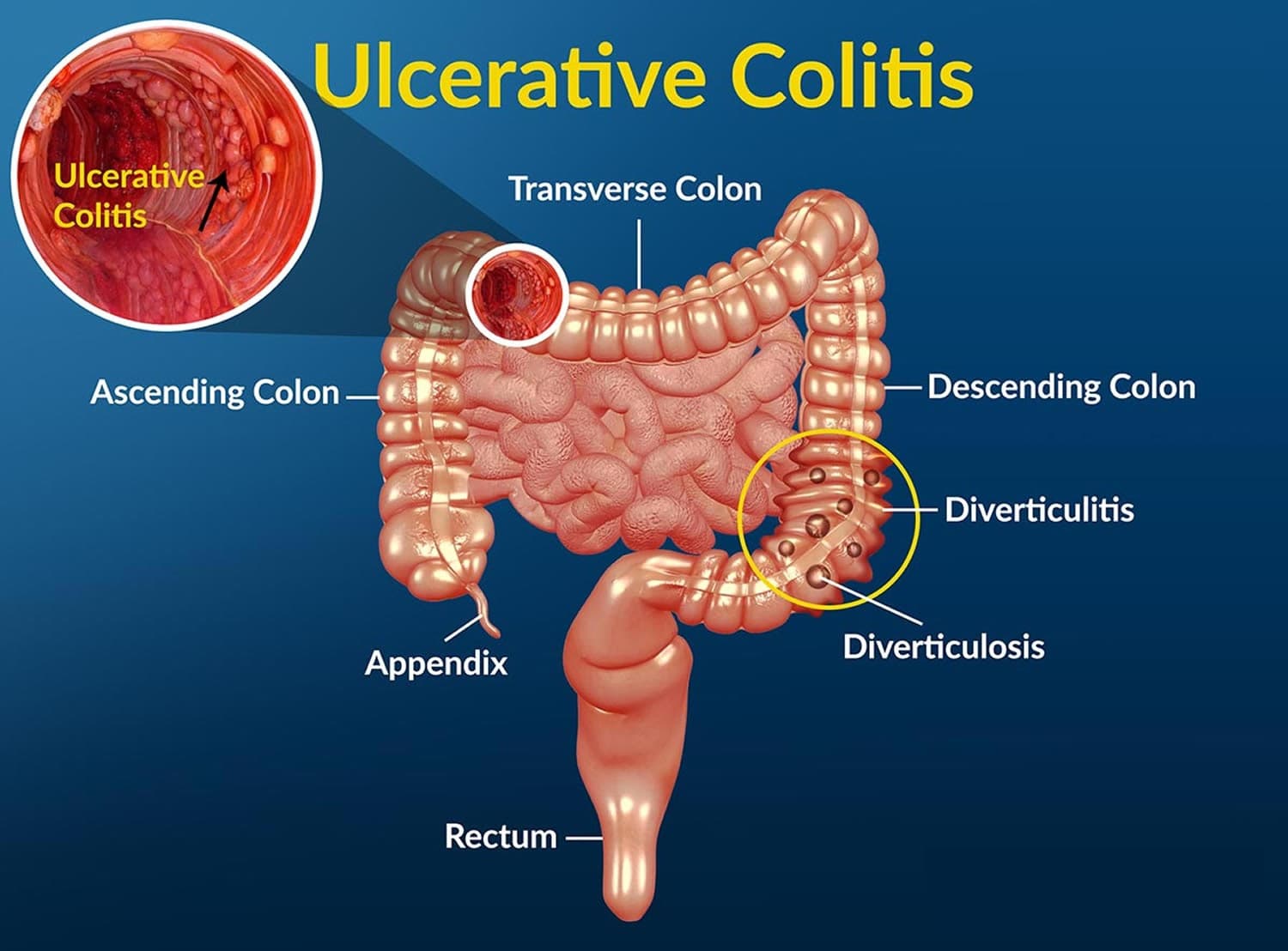
Ulcerative colitis (UC) is a chronic autoimmune condition causing continuous inflammation and ulceration of the colonic mucosa, starting from the rectum and extending proximally. It follows a relapsing-remitting course — periods of active disease alternating with remission. The condition profoundly affects quality of life through urgency, bloody diarrhoea, and the anxiety of unpredictable bowel control.
Constitutional homeopathy offers meaningful support for UC — reducing inflammation, controlling active disease, and helping maintain remission. It is most effective when used as a complement to conventional gastroenterology care, enabling many patients to achieve better disease control with lower medication burden over time.
Rising
UC incidence in urban India — doubling each decade
30–50%
Patients who achieve remission with constitutional treatment
98%
Patient satisfaction at HealthKunj
What Is It?
In UC, the immune system mounts a dysregulated inflammatory response against the colonic mucosa, leading to ulceration, bleeding, and impaired barrier function. The inflammation is characteristically continuous (no skip lesions) and confined to the mucosal layer, beginning at the rectum and varying in proximal extent. Understanding the disease extent is critical because it determines risk, treatment intensity, and surveillance requirements.
Proctitis (Rectum Only)
Inflammation limited to the rectum. Produces rectal bleeding, urgency, and tenesmus but often without systemic symptoms. Most amenable to conservative management including homeopathy.
Left-Sided Colitis
Inflammation extending from rectum to the splenic flexure. More significant symptoms with higher stool frequency and greater systemic impact. Requires conventional treatment alongside constitutional homeopathy.
Extensive / Pancolitis
Inflammation involving the entire colon. Highest risk of complications, systemic features, and long-term colorectal cancer risk requiring regular colonoscopic surveillance. Conventional treatment is essential; homeopathy complements.
Common Symptoms
Bloody diarrhoea — stools with fresh blood and mucus
Urgency to defecate, often with little warning
Tenesmus — constant feeling of needing to pass stool
Abdominal cramping, particularly in the lower left quadrant
Frequent, small, loose stools — sometimes 10–20 per day in severe flares
Fatigue and anaemia from chronic blood loss
Weight loss and poor appetite during active disease
Fever and malaise during moderate-to-severe flares
Joint pain (arthritis associated with IBD)
Skin rashes and eye inflammation (extraintestinal features)
Rectal pain and soreness
Anxiety and depression from the impact on daily life
Benefits of Homeopathy for Colitis
Reduces Flare Frequency and Severity
Constitutional homeopathy modulates the colonic immune response, extending periods of remission and reducing the intensity of flares — allowing patients to reduce dependence on steroids.
Controls Bloody Diarrhoea
Remedies such as Merc Cor, Aloe Socotrina, and Nux Vomica are highly effective at reducing the frequency of bloody, mucus-laden stools and the associated urgency and tenesmus.
Heals Colonic Mucosa
Constitutional treatment supports mucosal healing in the colon, reducing the depth and extent of ulceration over time — often reflected in improved colonoscopy findings.
Addresses the Autoimmune Driver
UC is an immune-mediated condition. Homeopathy works on the constitutional immune regulation — the deeper level that aminosalicylates and immunosuppressants manage but do not fundamentally alter.
Reduces Steroid Dependence
Many UC patients are caught in cycles of steroid courses. Constitutional homeopathy, used alongside prescribed treatment and with gastroenterologist guidance, can reduce the frequency of steroid requirements.
Improves Nutritional Status and Energy
As colitis is controlled and intestinal absorption improves, patients experience better nutrition, reduced anaemia, improved weight, and significantly better energy levels.
Our Homeopathic Approach
Disease Extent and Activity Assessment
We review colonoscopy findings, disease extent (proctitis, left-sided, pancolitis), and current disease activity using established scoring. Severe or fulminant colitis requires urgent hospital management — homeopathy supports stable and mild-moderate disease.
Detailed Symptom Case-Taking
The precise character of stools, urgency, tenesmus, blood quantity, timing, and modifiers is documented. In UC, the individuality of presentation — even within the same diagnosis — determines remedy selection.
Constitutional and Miasmatic Analysis
UC frequently runs in families and has a strong miasmatic (hereditary) component. We assess the constitutional type, family history, emotional profile, and any triggering events (infection, antibiotics, stress) that initiated the disease.
Remedy Prescription
Merc Cor (bloody tenesmus, burning in rectum), Aloe Socotrina (urgency, mucus, insecurity of rectum), Nitric Acid (rectal ulceration with splinter pain), Phosphorus (rectal bleeding, better cold drinks), and Sulphur (morning urgency, itching, burning) are among frequently indicated remedies.
Integrated Care Coordination
We work alongside your gastroenterologist, reviewing investigations at agreed intervals and never recommending medication reduction without specialist guidance. Our role is to complement, not replace, conventional UC management.
Frequently Asked Questions
What is the difference between ulcerative colitis and Crohn's disease?▾
Ulcerative colitis affects only the colon and rectum, with continuous mucosal inflammation starting from the rectum. Crohn's disease can affect any part of the GI tract, is patchy, and penetrates the full bowel wall. Both are treatable with constitutional homeopathy, but the approach differs.
Can homeopathy prevent colectomy (colon removal surgery)?▾
In mild-to-moderate UC, consistent constitutional treatment significantly reduces disease activity and may help avoid colectomy by extending remission. Severe or dysplasia-associated UC may still require surgery — and homeopathy should not delay this decision when surgery is medically indicated.
How long does it take to see improvement with homeopathy?▾
Most patients with mild-to-moderate UC notice reduced stool frequency and blood within 6–10 weeks. Sustained remission typically requires 9–18 months of constitutional treatment.
I am on mesalazine. Can I take homeopathy as well?▾
Yes. Homeopathic remedies can be safely taken alongside mesalazine (5-ASA) and all other UC medications. We never ask patients to reduce prescribed medication without their gastroenterologist's guidance.
What should I eat during a UC flare?▾
During active flares, a low-residue diet (white rice, boiled potatoes, cooked vegetables without skins, white bread) reduces mechanical irritation. Avoid raw vegetables, seeds, spicy foods, dairy if intolerant, and alcohol. We provide detailed dietary guidance tailored to your disease extent.
Can stress trigger UC flares?▾
Yes — stress is one of the most commonly identified triggers for UC flares. The gut-brain axis is strongly implicated in IBD. Constitutional homeopathy addresses this stress-gut relationship directly, which is one of its most significant advantages over purely local treatments.
Patient Stories
"I was having 12–15 bloody stools a day during my worst flare. Within three months of constitutional treatment alongside my mesalazine, I was down to 2–3 normal stools. A year later I have had no flares."
✓ Stool frequency reduced from 15 to 2 per day; sustained remission for 12+ months
Aditya Wagh
Patient since 2021, Wakad"The anxiety and social isolation from not knowing when urgency would hit was worse than the physical symptoms. Homeopathy addressed both — my UC is in remission and my confidence has returned. I can live normally again."
✓ UC in remission; anxiety and quality of life significantly improved
Nandini Kulkarni
Patient since 2022, Koregaon ParkWhat to Inform Your Doctor
- 1
UC extent confirmed on colonoscopy: proctitis, left-sided colitis, or pancolitis
- 2
Current disease activity: how many stools per day, amount of blood, any fever
- 3
All current medications: mesalazine, azathioprine, steroids, biologics — with dosages
- 4
Most recent colonoscopy report and biopsy findings
- 5
Latest blood tests: CRP, ESR, haemoglobin, iron, faecal calprotectin
- 6
History of steroid courses and how many in the past year
- 7
Any previous hospitalisations for severe flares
- 8
Dietary triggers you have identified
- 9
Psychological impact: anxiety, depression, social restriction
- 10
Family history of IBD or autoimmune disease
Preparing for Your Appointment
Recent Colonoscopy Reports
Bring the most recent colonoscopy and biopsy reports — disease extent and mucosal appearance guide treatment planning.
Complete Medication List
Include all UC medications with exact dosages — mesalazine, azathioprine, steroids, biologics.
Stool Diary
Track bowel frequency, blood and mucus content, urgency, and pain for one week before your appointment.
Blood Test Results
Recent CRP, ESR, haemoglobin, iron studies, and faecal calprotectin if available.
Allow 60 Minutes
UC consultations are comprehensive. Please allow a full hour for your first appointment.
Inform Your Gastroenterologist
Let your gastroenterology team know you are pursuing complementary homeopathic care for best-integrated management.
Ready to start your healing journey?
Book your consultation with Dr. Meera Thakur at HealthKunj Clinics, Pune.
Book Your Consultation